Urban Heat Island Effect: Why Cities Need Microclimate Analysis
The science behind urban heat islands, their health and economic impacts, and how site-specific evidence can support a proportionate EU Taxonomy assessment.
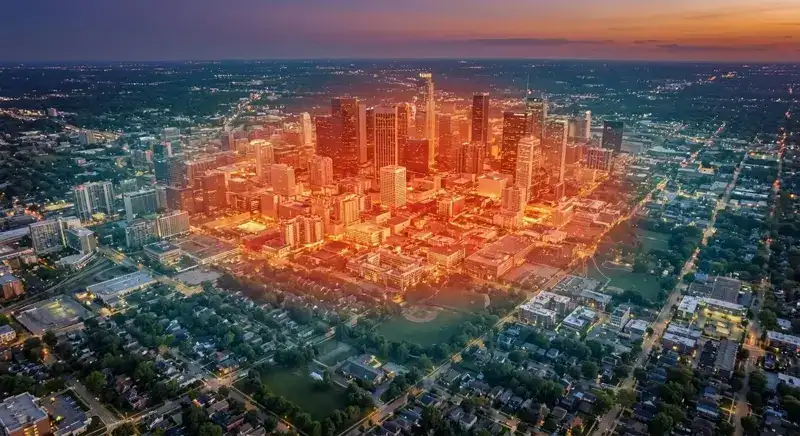
Walk from a park into a city centre on a summer afternoon and you will feel the temperature rise. That sensation is not subjective - urban areas can be measurably warmer than their surroundings, with intensity varying by city, site, season, and measurement method. This is the Urban Heat Island (UHI) effect, and it can be relevant to EU Taxonomy evidence where local climate risks are material, as well as to public health and urban planning.
What Causes Urban Heat Islands
The UHI effect results from a combination of physical factors that alter the energy balance of urban areas compared to rural surroundings:
Surface materials. Asphalt, concrete, and dark roofing absorb and retain far more solar radiation than vegetation or soil. Dark paved surfaces can become substantially hotter than shaded or vegetated surfaces.
Reduced vegetation. Trees and green spaces cool the air through evapotranspiration - the process of water evaporating from soil and plant surfaces. Dense urban areas with minimal vegetation lose this cooling mechanism.
Building geometry. Tall buildings create street canyons that trap heat and reduce wind flow. Solar radiation enters the canyon during the day but longwave radiation cannot easily escape at night, maintaining elevated temperatures after sunset.
Waste heat. Air conditioning, vehicles, industrial processes, and building energy systems all release waste heat into the urban atmosphere - a feedback loop where cooling buildings heats the city.
Reduced sky view factor. In narrow street canyons, buildings block the view of the sky from street level. This reduces radiative cooling at night, which is why UHI intensity often peaks during nighttime hours.
Observed Patterns
Reported UHI intensity varies substantially with urban form, weather, season, measurement method, and the boundary used for comparison.
European heat waves have been associated with substantial excess mortality, and dense urban neighbourhoods can face disproportionate exposure when UHI amplifies already extreme temperatures. The size and distribution of impacts depend on the event, population, and method used to estimate excess mortality.
These are observations from events that have already occurred, while climate projections indicate that heat extremes may become more frequent or intense across a range of future scenarios.
Health Impacts
Heat stress affects human health through multiple pathways:
- Cardiovascular strain - the body works harder to regulate temperature, increasing heart rate and blood pressure
- Respiratory effects - heat accelerates the formation of ground-level ozone, worsening air quality
- Heat stroke and exhaustion - direct thermal stress, particularly affecting the elderly, young children, and outdoor workers
- Sleep disruption - elevated nighttime temperatures (driven by UHI) prevent physiological recovery
- Mental health - emerging research links sustained heat exposure to increased aggression, reduced cognitive performance, and elevated rates of emergency psychiatric admissions
The populations most vulnerable to heat are concentrated in cities: the elderly, those with pre-existing conditions, low-income residents without air conditioning, and outdoor workers.
Economic Impacts
Beyond health, UHI can create economic impacts:
- Energy consumption - local heat can increase cooling demand; quantify the effect for the specific site and building.
- Labour productivity - heat stress can reduce outdoor work capacity; use an appropriate thermal-stress index and local evidence.
- Infrastructure stress - roads soften and deform, rail tracks buckle, power grids face peak demand precisely when they are least efficient.
- Property values - heat exposure can affect operating costs and asset decisions, but does not by itself establish a regulatory conclusion.
The EU Taxonomy Connection
Where an activity's applicable criteria invoke Appendix A of the Climate Delegated Act (EU) 2021/2139, its CRVA must identify hazards that may affect the activity. Appendix A's list includes heat wave, changing temperature, and heat stress; UHI may influence local exposure to those hazards.
Appendix A makes the assessment proportionate to scale and expected lifespan. Activities expected to last under 10 years use projections at least at the smallest appropriate scale; all others use highest-available-resolution, state-of-the-art projections. That rule does not automatically equate to building-level modelling. For a long-lived building in a dense urban area, the assessment should test whether regional data adequately represents any material UHI-related risk.
Consider the difference: a regional climate projection describes a broader baseline, while a south-facing street canyon surrounded by concrete and asphalt can experience materially different conditions because of UHI, reflected radiation, and reduced wind flow. A building's actual climate exposure may therefore differ from the regional average.
Appendix A's indicative, non-exhaustive list of 28 physical climate hazards includes "heat wave," "changing temperature (air, freshwater, marine water)," and "heat stress." Where these hazards may affect an urban building, ignoring material UHI effects can understate the actual risk.
Why Standard Weather Data Falls Short
Standard meteorological data comes from weather stations, which are typically located at airports, on building rooftops, or in rural/suburban areas - precisely the locations where UHI effects are minimal. These measurements represent regional climate conditions, not the microclimate at a specific urban building site.
The gap between regional data and local reality can be large enough to change the outcome of a CRVA. A building assessed as "low risk" for heat stress using regional data might be "high risk" when local conditions are properly modelled.
This is not a theoretical concern. Thermal comfort indices like PET (Physiological Equivalent Temperature) and UTCI (Universal Thermal Climate Index) show that localised conditions - wind speed at pedestrian level, mean radiant temperature from surrounding surfaces, shading from buildings and trees - dominate outdoor thermal comfort. Nearby locations in the same city can therefore have materially different comfort conditions.
What Microclimate Simulation Provides
Computational Fluid Dynamics (CFD) simulation resolves the physics that create microclimates. By modelling the interaction between buildings, surfaces, vegetation, and atmospheric conditions, CFD produces:
- Wind flow patterns around and between buildings, including wind tunnelling, sheltering, and pedestrian-level comfort
- Temperature distribution accounting for solar radiation, surface heat storage, shade patterns, and convective heat transfer
- Thermal comfort maps using indices like UTCI and PET that integrate temperature, wind, radiation, and humidity
- Scenario comparison - quantifying the impact of design interventions (green roofs, tree planting, surface material changes) before they are built
Where proportionate, CFD can complement screening with quantitative, site-specific evidence grounded in a physical model. It does not by itself establish taxonomy alignment or replace the CRVA's other steps, and its value depends on inputs, methodology, validation, and documentation.
Nature-Based Solutions and the UHI
Appendix A says adaptation solutions should consider nature-based solutions or rely on blue or green infrastructure to the extent possible. This aligns directly with effective UHI mitigation strategies:
- Urban trees provide shade, reduce surface temperatures, and cool the air through evapotranspiration; the effect depends on species, size, weather, and maintenance.
- Green roofs can reduce rooftop heat, manage stormwater, and support building performance; the effect depends on design, weather, and maintenance.
- Permeable surfaces allow water infiltration and evaporative cooling, replacing the heat-absorbing asphalt that drives UHI.
- Green facades shade building walls, reduce solar heat gain, and create a cooling microclimate adjacent to the building.
Microclimate simulation can quantify the impact of these interventions and support a documented assessment where that detail is proportionate. The regulation does not require simulation or CFD.
From Diagnosis to Action
Understanding the UHI effect is the first step. A practical workflow for translating it into an adaptation assessment is below; these are not additional statutory steps:
- Screen your building location by considering as a minimum Appendix A's indicative, non-exhaustive list of 28 physical hazards, plus any other locally relevant hazards
- Assess whether regional data captures material local conditions and, where proportionate, add site-specific evidence; high-resolution simulation is one option
- Design adaptation measures that address identified risks, prioritising nature-based solutions
- Document the assessment and adaptation strategy for taxonomy reporting and auditing
The EU Taxonomy does not prescribe specific tools. For activities under 10 years, Appendix A uses the smallest-appropriate-scale rule; for all others, it uses the highest-available-resolution rule, with the overall assessment proportionate to scale and lifespan. Microclimate-level analysis may therefore be useful where UHI is material, but it is not automatic.
Explore the full UHI explainer on this site, or learn how CFD simulation may provide optional site-specific evidence. Its suitability and acceptance depend on the model, inputs, documentation, and review context.