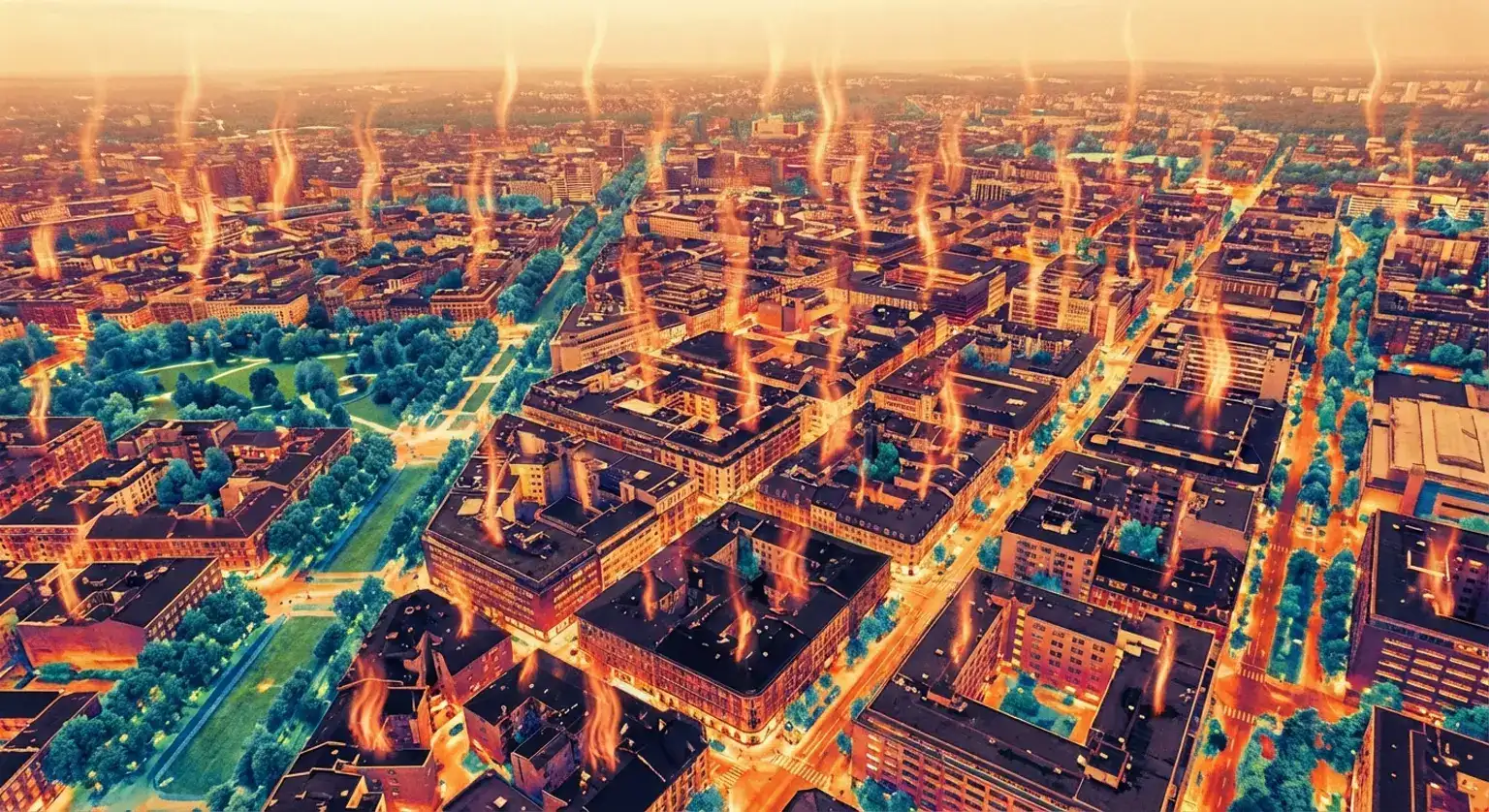
Urban Heat Island & Microclimate
Cities can be warmer than surrounding rural areas. Where local heat is material, this urban heat island effect can be relevant to an activity’s climate-risk assessment under the EU Taxonomy.
What is the Urban Heat Island Effect?
The urban heat island (UHI) effect occurs when cities experience significantly higher temperatures than surrounding rural areas. This is caused by:
- -Dark surfaces such as asphalt and roofing that absorb and re-radiate solar energy
- -Reduced vegetation eliminating natural cooling from evapotranspiration
- -Building geometry trapping heat in street canyons and blocking wind
- -Waste heat from air conditioning, vehicles, and industrial processes
Why UHI Matters for the EU Taxonomy
Heat Stress - Chronic Hazard
Listed in Appendix A of Delegated Regulation 2021/2139 as a chronic physical climate risk. Buildings in UHI-affected areas may face amplified heat stress that regional standard weather data does not fully capture.
Heat Wave - Acute Hazard
UHI intensifies the impact of heat waves in cities. A heat wave that is manageable in rural areas can become dangerous in dense urban environments where nighttime cooling is suppressed.
CRVA Requirement
Where Appendix A applies, projection resolution follows the activity’s expected lifetime: under 10 years, the smallest appropriate scale; for longer lifetimes, the highest available resolution across a suitable future-scenario range. It does not prescribe CFD.
Adaptation Solutions
Implemented solutions must not adversely affect the adaptation efforts or resilience of others. Evidence depth remains proportionate; CFD may help investigate local UHI effects but is not universally required.
"Standard weather station data covers regions. Microclimate modelling covers your specific building site."
A weather station 5 km away cannot tell you the wind speed at pedestrian level next to your building, or the temperature difference between a shaded courtyard and an exposed south-facing facade.
What Microclimate Modelling Provides
Microclimate simulation analyses climate conditions at the scale of meters to kilometres - the level at which buildings and urban spaces actually experience weather.
Temperature Mapping
Air and surface temperature at building level. Identifies hot spots, cool zones, and the effect of shading and vegetation.
Wind Flow Analysis
3D wind patterns around buildings. Identifies wind tunnels, stagnation zones, and pedestrian comfort at ground level.
Thermal Comfort
Indices such as PET and UTCI quantify how comfortable outdoor spaces are for people.
Optional CFD for Local UHI Questions
CFD is one modelling option for site-specific wind and thermal comparisons. Where local UHI effects are material and this detail is proportionate, it can support a CRVA; it is neither a prescribed method nor a Taxonomy requirement.