Climate Adaptation vs. Mitigation: Understanding Both EU Taxonomy Objectives
How climate adaptation and mitigation differ, why the taxonomy treats them separately, and what this means for buildings and urban development.
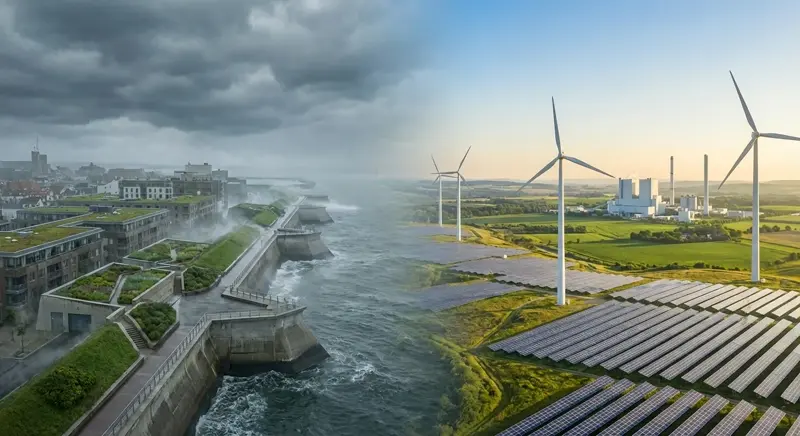
The EU Taxonomy's first two environmental objectives - climate change mitigation and climate change adaptation - are the most mature, with technical screening criteria defined since the Climate Delegated Act of June 2021. Yet many companies conflate them. They are distinct objectives with different logic, different criteria, and different implications for compliance.
Mitigation: Reducing Emissions
Climate change mitigation is about reducing greenhouse gas emissions. Activities that substantially contribute to mitigation either directly avoid emissions (renewable energy generation, energy-efficient buildings) or enable others to do so (manufacturing insulation materials, building EV charging infrastructure).
The criteria are typically quantitative: a new building must achieve a Primary Energy Demand at least 10% below the NZEB threshold. A renovation must deliver at least a 30% reduction in PED. These are measurable, engineering-driven targets.
Mitigation is backward-looking in the sense that it addresses the cause of climate change - accumulated and ongoing emissions.
Adaptation: Preparing for Impact
Climate change adaptation is about resilience. It recognises that even under the most optimistic emission reduction scenarios, the climate is already changing and will continue to change for decades. Activities that substantially contribute to adaptation reduce the vulnerability of people, infrastructure, and ecosystems to physical climate impacts.
The criteria are process-driven rather than threshold-driven. The central requirement is the Climate Risk and Vulnerability Assessment (CRVA) - a systematic identification of physical climate risks, assessment of vulnerability and exposure, and implementation of adaptation solutions.
Adaptation is forward-looking: it asks what climate conditions the building or infrastructure will face over its expected lifetime and whether it is designed to withstand them. Appendix A makes the assessment proportionate to the activity's scale and expected lifespan; for major investments, it includes at least 10–30-year climate projection scenarios.
Why the Taxonomy Separates Them
The distinction matters because an activity can excel at mitigation while being completely unprepared for adaptation - and vice versa.
Consider a highly energy-efficient building with a strong mitigation contribution in a city with material projected heat risk. Without a proportionate assessment and suitable adaptation measures where the criteria require them, that building may remain vulnerable during heat waves despite its excellent energy rating. It can contribute substantially to mitigation while still failing the DNSH test for adaptation.
Conversely, a climate-resilient building with green roofs, shading, and flood protection (strong adaptation) might have mediocre energy performance. It addresses future climate impacts but does not substantially contribute to reducing emissions.
The taxonomy requires both: substantial contribution to at least one objective, and DNSH to all others.
The DNSH Connection
This is where the two objectives interact most directly. Where a building activity's mitigation DNSH criteria invoke Appendix A, they require its climate risk and vulnerability assessment. This means:
- Considering as a minimum the 28 hazards in Appendix A's indicative, non-exhaustive list
- Using state-of-the-art climate projections across an existing range of future scenarios consistent with the activity's expected lifetime; Appendix A's footnote names RCP 2.6, 4.5, 6.0, and 8.5
- Using at least the smallest appropriate scale for activities expected to last under 10 years, and the highest available resolution for all other activities
- Implementing adaptation solutions for material risks
- Considering nature-based solutions or blue and green infrastructure to the extent possible
An Appendix A assessment is mandatory where the climate-adaptation DNSH criteria for the relevant mitigation activity invoke it.
Adaptation in Dense Urban Areas
The adaptation challenge is particularly acute in cities. The Urban Heat Island (UHI) effect can amplify local heat exposure in urban areas compared with their surroundings. Standard climate data - typically measured at meteorological stations outside city centres - may not fully capture these local conditions.
Appendix A applies the "highest available resolution" rule to activities expected to last 10 years or more; shorter-lived activities must use projections at least at the smallest appropriate scale. For long-lived urban buildings, this raises a practical question: is regional climate data sufficient, or would site-specific analysis improve the assessment?
For a suburban warehouse, regional data may suffice. For a residential tower in a dense city centre where street geometry, surrounding buildings, and surface materials dramatically alter local wind and temperature patterns, site-specific evidence may be proportionate. CFD-based microclimate simulation is one optional way to provide it; the regulation does not prescribe CFD, and the method and documentation still need to withstand project-specific review.
Practical Examples for Buildings
New Office Building (Activity 7.1)
Mitigation path: Design to 10%-below-NZEB PED threshold. Install heat pump systems, high-performance insulation, and rooftop solar. Adaptation DNSH: Where the activity's criteria invoke Appendix A, consider its indicative, non-exhaustive hazard list as a minimum. Identify heat stress as a material risk under the selected scenario and horizon. Implement external shading, a green roof, and a natural ventilation strategy. Document the assessment and measures in the building design report.
Major Renovation (Activity 7.2)
Mitigation path: Achieve 30% PED reduction through envelope upgrade, window replacement, and HVAC modernisation. Adaptation DNSH: CRVA identifies pluvial flood risk (increased extreme rainfall under RCP 4.5). Install sustainable urban drainage, permeable paving in surrounding areas, and waterproofing for below-grade spaces.
Portfolio Acquisition (Activity 7.7)
Mitigation path: Verify EPC class A or top-15% national benchmark. Adaptation DNSH: For each asset in the portfolio, screen climate hazards relevant to its location. Prioritise detailed CRVAs for assets in high-risk zones (coastal areas, flood plains, heat-island-affected urban cores).
Why Adaptation Is Underserved
Despite being one of the two original taxonomy objectives with criteria since 2021, climate adaptation receives far less attention than mitigation. There are several reasons:
Mitigation criteria are simpler. A PED threshold is a single number. A CRVA is a multi-step process involving scenario analysis, hazard screening, and solution design.
Adaptation requires forward-looking data. Energy performance can be measured from current building specifications. Adaptation requires climate projections - and the quality of those projections matters for compliance.
There is less commercial infrastructure. Energy modelling tools are mature and widely used. Climate risk assessment tools for individual buildings are newer, and high-resolution microclimate analysis has historically required specialist expertise.
This gap is closing. Tools for building-level climate risk assessment are improving, and the regulatory pressure is increasing. Commission Delegated Regulation (EU) 2026/73, adopted in 2025, simplified taxonomy reporting and certain pollution-related DNSH criteria; it did not amend the climate-risk criteria in Appendix A. The criteria for the relevant activity still determine when Appendix A applies.
Moving Forward
The taxonomy treats adaptation and mitigation as complementary, not competing. A genuinely sustainable building addresses both: it minimises its contribution to climate change through energy efficiency and renewable energy, and it is designed to withstand the climate conditions it will face over its lifetime.
For companies navigating taxonomy compliance, the practical advice is clear: do not treat adaptation as secondary to mitigation. Start the CRVA process early, use appropriate climate data for your building's location, and integrate adaptation measures into design from the outset.
Explore both objectives on this site: climate change mitigation and climate change adaptation, or dive into the full climate adaptation hub for detailed guidance on CRVAs, physical hazards, and nature-based solutions.